Buy Print Online, Call 1-800-707-9903 or Email
 

Print that Works Harder

Print 2.0: Smart Print that Works Harder

By Lorrie Bryan


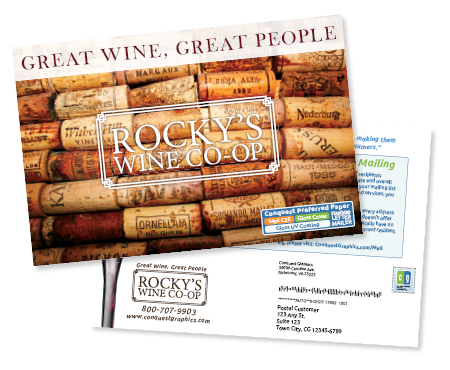
The owner of a local family restaurant decides to increase business by spending some money on advertising, and a friend suggests she should use an e-mail blast to promote her restaurant. She considers this—she is an avid Internet user and has had a Facebook account for awhile. But she knows how much she hates getting intrusive e-mails and how few of these she ever actually reads. Everyone else probably feels as bombarded with electronic media as she does. In contrast, at the end of the day, people like herself, her target audience, might be happy to find an attractive postcard in the mail that offers a discount on dinner at a nearby restaurant. So she makes a call to her local printer—the guy who had printed her menus last year—and schedules an appointment to talk with him about ordering direct mail postcards.

The restaurateur anticipates a short meeting to discuss how many cards and how much they will cost. Instead, her printer asks a lot of questions about her objectives and explains how they could use Internet technology and social networking along with direct mail postcards to not only increase restaurant traffic but also establish a customer data base for future use. He shows her case studies with impressive response rates.

After careful consideration, she decided to go with the custom campaign her printer-turned-MSP (marketing service provider) created for her restaurant. Attractive postcards that directed users to a personalized URL (PURL) were mailed to 5,000 area families. More than 25 percent of the postcard recipients logged on to their PURL to activate a coupon offering a complimentary children’s dinner with the purchase of an adult dinner. Users validated their information on the first screen, selected the offer they wanted to activate and answered a few questions.
 
Next, users were given the capability to effortlessly share the offer on Facebook. As an incentive, all recipients who shared the offer with friends were automatically entered into a sweepstakes to win 10 free family dinners. After completing the process, users were able to print the offer (if they had not received the offer in the mail) and bring it into the restaurant for redemption. More than 1200 users opted to post the offer on their Facebook walls which brought in an additional 6500 users, resulting in an amazing total of 7,700 responses to the initial 5,000 postcards. The restaurateur increased business significantly—she ended up redeeming 1250 coupons—and she went from having no data base to a full data base of qualified customers in just one campaign.

Fortunately this restaurateur selected a progressive printer, one that has made the transition to market service provider and understands how to leverage the inherent value of traditional print with Internet technology. The old adage says, “Work smarter, not harder.” Today’s print (we’re calling it Print 2.0) melds the virtues and value of traditional print with the intelligence and efficiency derived from digital technology to create smarter print. Here are the critical success factors for Print 2.0:

1. Know your customer

Successful marketing with old-fashioned print ads and/or high-tech QR codes begins with a thorough understanding of the person you are trying to engage. “Know how they behave, know them inside and out,” says Jonathan Turitz, creative director at VSA Partners, a premier graphic design and brand strategy consultancy. “All media is being tested in today’s world. Because we are so inundated with information, everyone is working harder to be heard. The key is to be smarter. For print advertising to succeed, you need to know your target audience’s psychographics as well as their demographics. What are their values, attitudes and interests? What are their lifestyles and their desired lifestyles?”
 
This was an easy one for our restaurateur because she is trying to engage people with a lifestyle and values similar to hers—women who are looking for an incentive to take their families out to dinner. A free child’s dinner is a good enticement.

2. Make your message as relevant as possible

Our restaurateur didn’t send postcards to everyone in a 10-mile radius; she strategically targeted families in neighborhoods within a few miles of her restaurant. Using the data she collected in this campaign, she can opt to make future mailings even more personal, more relevant.

The days of carpet-bombing marketing are numbered, according to Print Council Executive Director Ben Cooper. “Randomness has been replaced with relevance; volume has been replaced by targeting as a critical success factor for print. And a direct mail postcard has proven to be an effective vehicle for a relevant message.”
 
Although Internet ads strive to be relevant, they are frequently perceived as intrusive, and many Web users tend to ignore them. Unsolicited e-mails are sent straight to the spam file. Conversely, if you receive an attractive postcard in your mailbox from a local restaurant offering you a free child’s meal or a free meal on your birthday, you are more receptive and inclined to take action. If the restaurant you recently visited follows up with a thank-you postcard and a discount offer on your next visit, you are more likely to make plans to return. Not only are these messages relevant, but they arrive via a time-honored, often-anticipated source in a familiar, attractive format that you can hold in your hand and read at your convenience.

Since there is a proven correlation between the relevance of the message and the response rate, more and more direct mail pieces are utilizing variable data printing (VDP) technology for personalization, versioning and customization. The per-piece cost for VDP is higher,” notes Cooper. “But the higher response rates are causing marketers to think about the cost of printing differently. They stop thinking about the cost per piece and start thinking about the cost per response. Variable data printing costs more per piece but each piece can be significantly more relevant. Increased relevance means greater response and ultimately that leads to a greater return on investment.”

3. Use print in tandem with other marketing channels
 
Many marketing experts contend that seven is the magic number of times you should reach out to a prospective customer. Dr. John
Leininger, professor of Graphic Communications at Clemson University, says he tells his graphic communications students they should reach out to their clients in a variety of ways utilizing print as an integral element of a multi-channel campaign along with PURLs, QR Codes and e-mail. “By mixing the message across different media you increase the likelihood that the recipient will see the message. Many studies have shown that direct mail combined with cross-media in a multichannel campaign produces higher response rates.”

In our example, the addition of the PURL provides a mechanism to access the Internet while demonstrating the power of social media. Response rates exceeded 150 percent, and the restaurant now has a full data base of information for use in future campaigns.

4. Utilize digital tracking technology to optimize content

Not only are multi-touch campaigns more effective, they have the potential to increase efficiency and significantly reduce marketing spending by tracking responses and refining databases. Referred to as “print with intelligence built in,” PURLS and QR codes help segment prospects appropriately so that marketing strategy can be more specifically tailored and communication can be further personalized. “And it can all be automated,” Leininger says. Unlike mass mailings and generic blasts, automation programs offer tailored efficiency. Postcards and e-mails can be personalized and sent at designated time intervals based on predetermined parameters. Increasingly printers are taking on the role of managing this process as well and becoming innovators in database marketing and marketing automation.
 
 
“Printers are more attuned than ever before to the needs and goals of their customers, and they are equipping themselves to meet those needs by becoming marketing service providers, experts in multichannel marketing and data base management with print in the mix,” affirms Cooper. “There is no static state—everything is changing and growing. Printers are continually adapting, becoming smarter, taking on the burden of understanding how to use new marketing tools in this ever changing world,” he adds.

And the evolution of printers has led to the evolution of print, the emergence of Print 2.0.

“For print advertising to succeed, you need to know your target audience’s psychographics as well as their demographics. What are their values, attitudes and interests?” - Jonathan Turitz, creative director at VSA Partners

“By mixing the message across different media you increase the likelihood that the recipient will see the message.” – Dr. John Leininger,
professor of Graphic Communications, Clemson University