Buy Print Online, Call 1-800-707-9903 or Email

Conquest Graphics Blog

How to Save Money with On-Line Printing

by mariruth.kennedy@gmail.com
February 21, 2012 16:27

Just the simple act of ordering your print on-line rather than at a local printer will likely save you money.  Most on-line printers are large companies that do a significant amount of volume so they can pass their savings along to the customer.  On-line printers usually offer a wide variety of products from business cards to catalogs and a range of services that most local companies cannot match.  So next time you have a print project, get a quote from an on-line printer to see what type of savings they can offer you.

But before you place your order, here are some other printing tips that can save you even more: 

Higher Quantity = Lower Price Per Piece: 

One factor that comes into play is that printers give price breaks for placing larger orders.  Most of the actual costs in printing are in the set up and not in the production (or print run), so most printers pass along savings for larger orders. You get the price break and you get more copies of your brochure, flyer, catalog, etc.

However, you need to make sure that the extra copies will go to good use since it makes no sense to spend more if you cannot use the overage.  So, check to see if you have any pricing or expiration dates on your piece that may be an issue.  Do you have a mailing list with a finite number of customers?  In those cases, printing extra may not pay out.

Before you place the order, look at the quantity you need and then look at the printer’s price breaks.  If you plan to order 4,500 flyers, then the printer may offer a discount if you order 5,000 which makes it worthwhile to order more.  If you need only 600 mailers and the next price break is for 2,500 pieces, then stick to only what you need.  A smart print buyer pays attention to the discount brackets and orders accordingly.

Save Money on Direct Mail by Updating your List:

One mistake that will cost you money is not updating your customer mailing list. Sending mailings to addresses which are no longer valid is simply wasting money. Also, many lists contain duplicate addresses if both the husband and wife shop at your store.  Eliminating duplicate addresses is easy, but figuring out if someone has moved can be a bit more difficult. 

The Post Office offers an address updating service (NCOA) or you can remove names from your list if they have not shopped with you for a certain period of time.   Some retail businesses send a separate “Welcome Back” mailer to former customers with a strong offer or even a free gift to get them to return to the store.  If this doesn’t work, you may assume that the customer has moved away from the area or no longer needs your services.
   
You can also de-duplicate your mailing list, removing variations of the same customer.  John T. Smith and J.T. Smith may be the same person so be sure to delete one name if both addresses are a match.  This will save you a lot on postage.

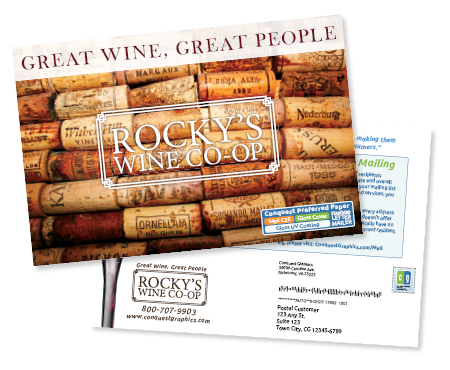
Speaking of postage, also look into postal regulations to determine the costs for various size mailers.  Obviously, postcard will cost less to mail than a catalog but a fraction of an inch can make a difference with mailing costs if you are not within specs.  For example, a small postcard measuring 6” x 4.25” gets the lowest rate so it does not make sense to mail a postcard that is 6” x 4.5” and pay the higher rate.  If you are paying for a large postcard, then it is worthwhile to print up to the biggest postcard size (11.5” x 6”) allowed.  If you have questions, you can check with your local post office for rates by size and weight.  Or go to www.usps.gov.  


Use standard paper stock for savings: 

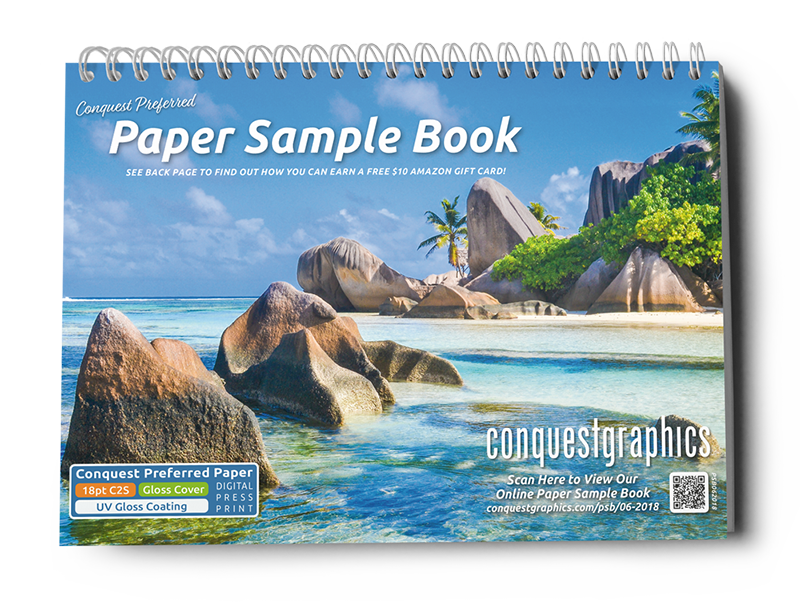
Most printers provide a variety of paper stock to choose from within their inventory.  On-line printers such as Conquest Graphics have different weights of paper in glossy or matte textures that will be best for 90% of most print jobs.  Ordering from their “menu” of paper will cost a lot less than ordering a special product.  For example, if you are printing brochures and your ad agency specifies a 9pt glossy card stock you may be better off ordering the 100lb cover stock that the print company has on-hand.  Many times, the difference between paper is negligible so long as you are close to the same weight class.  If you have questions, you can talk to customer service for advice on the closest match available or even get a sample sent to you for comparison.  Ordering special paper can drive up your costs so be sure that you have a good reason for getting a “custom” paper.  

These are just 3 tips that can save you money but at Conquest Graphics we want to help you make the best decisions on your printing.  Take a look at the variety we provide and do a price comparison on your next print project.  We believe that a well- educated customer is a happier customer.   Contact us today to see how we can help you save costs by offering you more efficiency.  


Green Printing: 5 Myths about Recycled Paper

by mariruth.kennedy@gmail.com
January 31, 2012 15:44

Recycled Paper

Green printing is on the rise, but there are still biases against using recycled papers. A study recent study in Britain found that over 1/3rd of business owners preferred not to use recycled paper due to outdated reasoning.  Here are the top 5 myths that were cited:  


Myth 1: Recycled paper just doesn’t look as good.  It is not as professional and it is not as smooth and white as non-recycled paper.
Fact: Over the years, there have been huge improvements in the quality of recycled paper and many people could not tell the difference between virgin and recycled paper without a notation that states the paper is recycled.  There are different grades of paper available depending on your print needs but if you want an ultra-white, smooth paper, then you can get that with recycled products today.


Myth 2: The print quality isn’t as clear on recycled paper.  The ink tends to bleed and the color isn’t as vibrant.
Fact: There is no difference in print quality on recycled vs. non-recycled paper.  The ink coverage and color concentration will be the same depending on the grade of paper used (recycled or not).


Myth 3: Recycled paper costs more than regular paper.  
Fact: The difference in paper costs is narrower than in the past and the most commonly used grades of recycled paper are only slightly higher than virgin paper. Buying in bulk and with adequate lead time can help minimize the small cost difference.


Myth 4: All paper is recycled these days so you do not need to make a special request for it.
Fact: Actually 90% of the paper used today is made from virgin fiber even though recycled paper is more available today than years past.  Because many customers assume that paper is recycled, they do not ask before placing a print order.  Look for a green printer, such as Conquest Graphics, that are FSC (Forest Stewardship Council) certified or be sure to ask that your print job be printed on recycled paper.  


Myth 5: Recycling paper does not help the environment because the recycling process uses so much more energy.   
Fact: Recycling paper saves trees, energy and water and it produces less pollution.  The recycling process uses more benign chemicals and less bleach than needed to produce virgin paper.  Plus, reusing the paper helps by not adding to the landfill problem.  


If you are concerned about the environment, then do your research before selecting a printer for your next project.  Recycling has many benefits and there are more green print companies available than ever.   Conquest Graphics is an FSC certified printer and allof our paper has some recycled materials.  We also use soy-based inks and print in an environmentally friendly printing plant.  


Tags: , , ,

Green | Paper

Brochure Printing - Choosing the RIght Paper

by mariruth.kennedy@gmail.com
January 12, 2012 10:44

When printing a brochure you want to make sure that your paper matches your purpose.The purpose of selecting the right paper for printing your brochure is simple: your great product or service needs to be showcased on a brochure which matches the quality of your product. That’s part of meeting your customers’ expectations.

The typical brochure customer is one who wants to use printed materials such as brochures, posters, and catalogs in order to showcase her business in the best possible light.

Here are five great ideas which will ensure that your brochure makes the right statement to potential customers:


1. Use a high gloss coating

if you are including photographs in your brochure. Let’s say you are marketing an expensive condominium. The customer is going to want to see every detail. A high gloss coating ensures that your color photos will show to maximum advantage. You increase your chances of making the sale when the customer doesn’t have to wonder what it is she’s looking at!

2. Use a heavy weight

of paper if the purpose if your brochure is intended to be kept for reference purposes or if you want to eliminate "show through" – print on the other side showing through. Sometimes people equate flimsy brochures with cheap products. If you are marketing a higher-end product or service, your money may be better spent elevating the quality of the brochure as opposed to the quantity.

3. Use coated paper

in almost every case. Using uncoated paper may save you money, but the ink may be absorbed unevenly and that will likely make a poor impression. At Conquest Graphics, the use of coated paper is standard.

4. Use a matte finish

if there are no photographs or if your brochure is somewhat technical in nature, and it depends on clarity in writing and little else. Too much in the gloss and flash department may be a distraction. Lowering the tone of the presentation may not only convey an image of seriousness, it can save you money as well.


5. Use environmentally friendly paper any chance you get.

This is not a coating or weight issue; this is the paper itself. If you can buy paper with a reasonable PCW (post-consumer waste) factor and it doesn’t degrade the quality or the look of your brochure, you should move in that direction. And of course, it’s vital that you advertise the fact that you have done this. In very small print at the bottom of one of the panels you should say

This brochure was printed using recycled materials.


Contact Conquest Graphics today to discuss your latest project. As a full service printer, we have experienced staff who can help you with selecting the right materials. High quality paper and coatings are not typically that much more expensive than the lesser quality materials. Let us help you explore your options.


Tag cloud